ExxonMobil 3518PA mLLDPE Cast Film Resin Buying Guide: Core Properties, Processing Advantages & Applications
Common Pitfalls in Cast Film Production
Most cast film defects trace back to one decision: the resin choice. Three problems repeat across plants. Additive precipitation weakens print adhesion and lamination bonds. Insufficient toughness causes film breakage and uneven thickness. Unstable melt flow triggers gel defects and melt sag on fast lines.
Many plants pick a low-cost conventional LLDPE to protect the material budget, and that choice often backfires later. A Plastics Technology review of slip agent behavior explains that slip additives migrate to the film surface over time rather than staying fixed in place. That same migration pattern is described as the hidden cause behind weak heat seals on packaging lines. Once migration builds up, print adhesion drops and seal strength becomes unpredictable. This is the exact failure pattern that pushes processors toward a benchmark resin such as ExxonMobil 3518PA.
Conventional LLDPE vs. 3518PA: A Clear Quality Gap
Conventional LLDPE usually ships pre-blended with antiblock and slip agents already mixed in. That convenience becomes a liability once migration starts, since a processor cannot turn it off mid-run. Thinner conventional film also needs extra gauge to survive tear and puncture stress, which raises material use per finished bag.
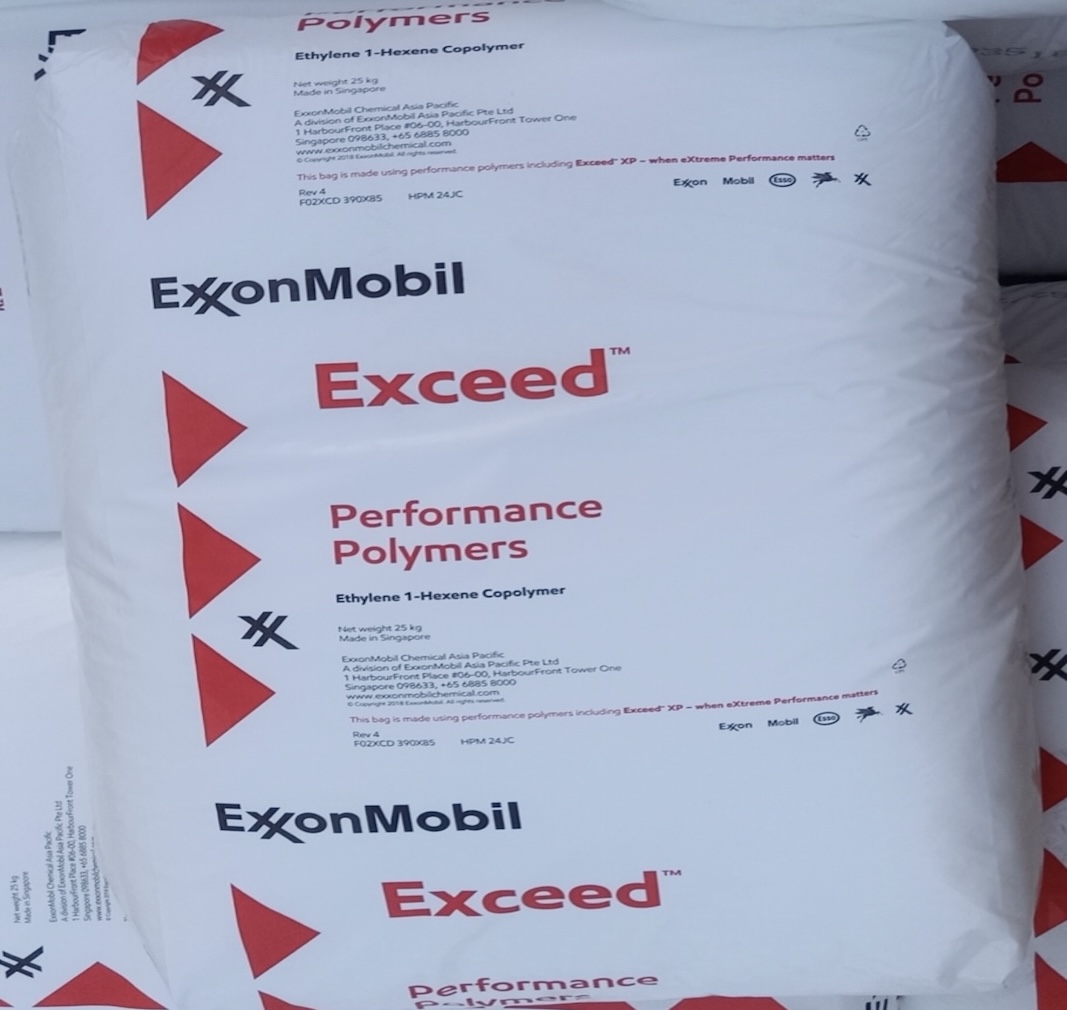
ExxonMobil built 3518PA differently. The official Exceed m 3518.PA product datasheet lists only a thermal stabilizer, with no pre-blended antiblock or slip package, handing full formula control back to the processor. The table below lines up the two options side by side.
| Property | Conventional LLDPE (typical) | ExxonMobil 3518PA |
|---|---|---|
| Density | 0.920–0.925 g/cm³ | 0.918 g/cm³ |
| Melt Index (190°C/2.16kg) | 1.0–2.0 g/10min | 3.5 g/10min |
| MD Tensile Strength at Break | ~40–50 MPa | 70 MPa |
| TD Elongation at Break | ~400–500% | 680% |
| Pre-blended Antiblock/Slip | Yes | No |
Core Advantages of 3518PA
Three strengths matter most once a line runs at speed. First, a resin with no pre-blended slip or antiblock package lets a processor dial in the exact friction and clarity a job needs. This is the same control principle behind a form-fill-seal packaging film patent that ties antiblock dosage directly to seal strength and machine handling. Second, higher tensile strength supports gauge reduction without losing toughness, so a thinner film can still pass the same drop test. Third, a wide processing window keeps melt flow steady through small trial runs and 24-hour continuous production, avoiding the gel spots and surface streaks that appear when a resin's window is narrow.
Scenario-Based Selection across Industries
3518PA covers three buyer groups. Packaging teams use it in food vacuum films, stretch wrap blends, FFS heavy-duty bags, and bag-in-box liners. Hygiene producers choose it for diaper backsheets and other breathable substrates, since a clean, precipitation-free surface matters more there than almost anywhere else. A peer-reviewed study on slip-agent surface behavior shows how additive migration changes surface texture even when bulk properties still look fine on a data sheet. Industrial buyers blend 3518PA with HDPE or EVA, in a 10–30% ratio, to build greenhouse film or cable carriers with whatever barrier or hardness a project needs. This is the same question we walk new customers through at Chengnuo: which of these three groups do you belong to, and does your current resin actually match that use case, or just its label.
Price per kilogram is rarely where cast film costs actually show up. They show up later, in scrap rate, seal rejects, and machine downtime. A heat-sealed polymeric film patent filing lays out this trade-off directly: pushing antiblock loading up to fix a slip problem raises haze and can scratch the film surface. A resin built to avoid that trade-off from the start is worth more than its price tag suggests.
Conclusion
3518PA is not the cheapest pellet on the shelf, but it removes the additive guesswork behind most cast film defects. For buyers chasing stable, high-speed output, that trade is usually worth making.
Reference
- ExxonMobil Chemical — Product Datasheet: Exceed™ m 3518.PA Cast Metallocene Polyethylene
- Plastics Technology (ptonline.com) — Slip Agents: Extended Performance Range for Polyolefin Films
- Siliketech — Slip Agent Migration — The Invisible Barrier to Strong Heat Seals
- USPTO Patent — Packaging Film (Anti-Blocking Agent for Form-Fill-Seal Operation
- Wiley / 4SPE Publications — A Study of Polyethylene Packaging Films in Presence of Slip-Agent and Anti-Block Additives
- USPTO Patent — Heat Sealed Polymeric Films